 more cities

You can paint upholstery? Yep, here’s how.
I spend a lot of time online. Like, a lot. Noodling through the internet is how I earn a living. It’s also what I do to relax. So, yeah… I see things. Amazing things, like painted upholstery. Yup. Painted upholstery has been cropping up in DIY blogs and on Pinterest for awhile now. I scrolled through photos of rather unbelievable before and after photos – dirty, grungy wing chairs transformed into stately jewel-toned marvels. And while I was pretty skeptical about painting fabric, there were just too many success stories to dismiss the idea outright.
Most of these success stories credited designer Kristy Swain’s step-by-step how-to posted on her blog Hypen Interiors. After reading and re-reading her post, I started to get pretty excited. Her before and after photos are impressive. The supply list is short and affordable, plus she has a list of links to successes AND failures of other people who’ve tried her tutorial. I’m a sucker for transparency.
I also had a rather ugly chair squatting in my front room that I ‘d recently picked up for free. I found it on Freecycle and I grabbed it because I liked the shape of it and the size. I had fantasies of recovering it until I looked into the cost/skill required. So, there it sat, in it’s scruffy beige glory, reminding me and more dangerously my family of how I sometimes fail to follow through with my creative projects. I had nothing to lose and half the supply list sitting in my basement. So, here’s my take on Kristy’s tutorial. I read all the links to other attempts on her page and kind of modified things.
Painted upholstery DIY
Supplies
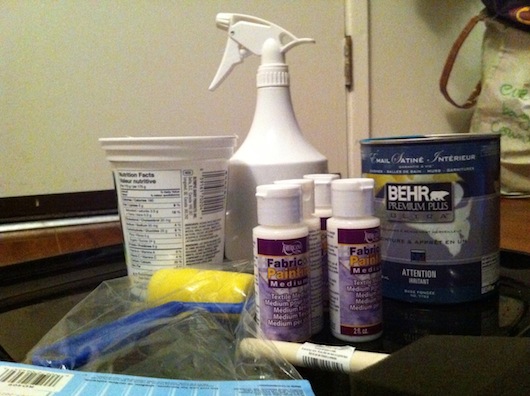
Nicely organized supplies
- Paint – I used 1/4 of a 887 ml can of Behr’s acrylic-latex Teal Zeal I had left over from painting my dining room wall
- Spray bottle filled with water
- Fabric softener (optional – but I feel it helps with softening the fabric)
- Paint brush – I used a crappy old paint brush as I knew I was going to be rough on it, plus a few good-quality sponge brushes in different sizes (one small one for nooks & crannies)
- Small sponge roller
- Fabric medium – how much you need depends on the size of your project. I bought Americana brand fabric medium from Michaels. They only sold them in 60 ml bottles, so I bought 4 and I used them all. If you can find a big bottle, I’d grab that. Otherwise, it’s better to have too much than too little. You can always return what you don’t use or save for another project.
Here we go
1) Vacuum or even better steam clean the piece of furniture you’re going to be working on. You’re going to want your upholstery damp anyway, so you won’t have to wait for things to dry if you give it a shampoo. I’m lazy, however and I couldn’t be bothered to borrow a steam cleaner. So, I just vacuumed it within an inch of it’s life.
2) Tape off any wood you don’t want painted. Trim off any cat scratch threads, etc & so on.
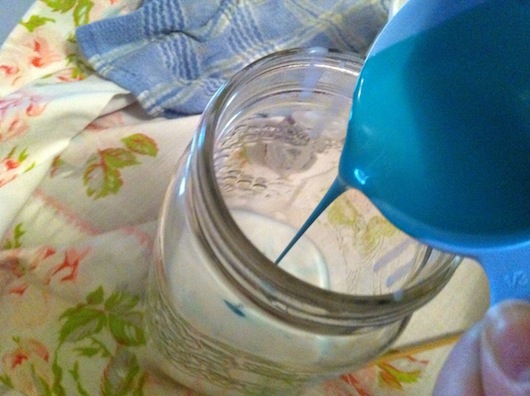
Pouring & mixing equal amounts
3) Mix equal parts paint, fabric medium and water into a large Mason jar. Mix thoroughly. You want the consistency of a glaze – like homogenized milk.
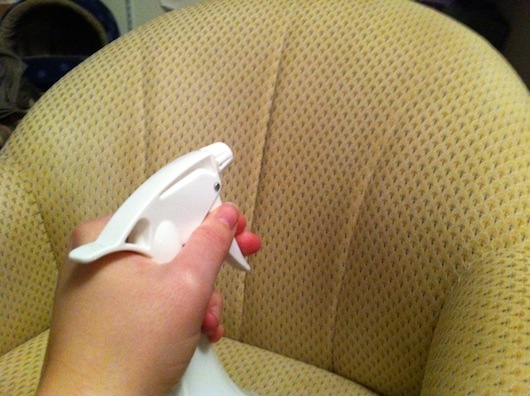
Mist the area you plan to paint first
4) Mist the area you are going to paint first with the spray bottle. You want the fabric pretty damp.
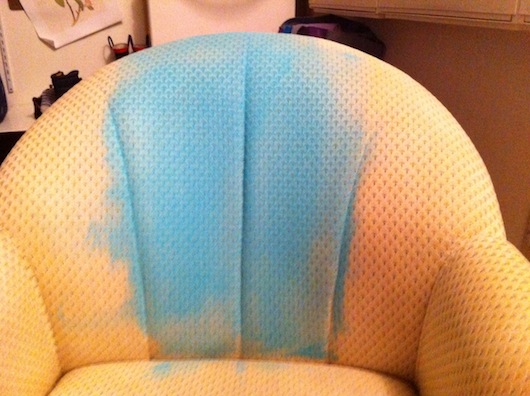
Brush on a thin layer of paint
5) Using your brush lay a very thin layer of paint on the fabric. Now, how you do this will really depend on your fabric. If you’re painting a velour, you’re going to want to make sure you paint in the direction of the grain so that the fabric lays in the right direction. My fabric was as man-made as can be — textured, but with no pile. So, I really worked the paint in using circular motions. Again, keep this thin. This is your base coat. If you lay it on too thick, you’ll end up with a gross texture.
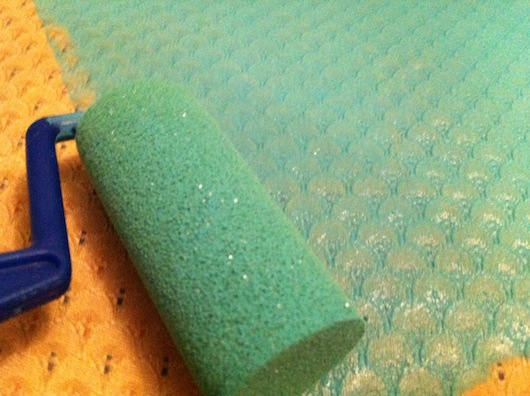
A sponge roller keeps things running smoothly
6) I spritzed a light mist of water over the painted bits and then ran over it with a damp sponge roller. I found this really evened out the coverage and removed any excess paint. Depending on how much surface you have to cover, you may want to roll on the paint, as well. I didn’t because I really wanted to work the paint into the fabric and I found a brush did a better job for me.

Don’t panic. This is part of the transformation.
7) Once you’ve got your base coat on the entire piece, let it dry completely. Depending on your fabric this could take a couple of hours or overnight. I left mine overnight as I was keeping the fabric quite wet and it was midnight by the time I finished. From start to finish, it took me about an hour to get the first base coat on.
Note: At this point your piece of furniture will look terrible. You might even feel a little sick. You’re going to want to keep any naysaying family members out of the room because you’ll be tired and you just might have an irrational over-reaction to some unwanted feedback. Or, so I imagine…
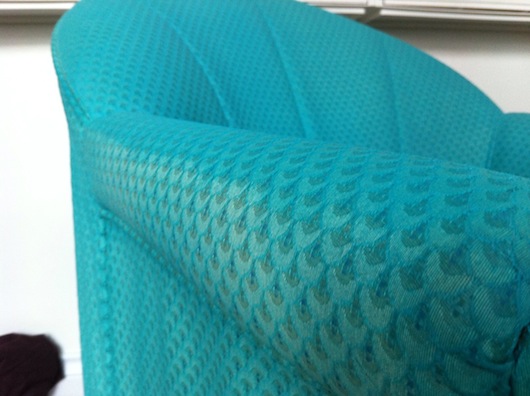
See the difference between the 2nd & 1st coats?
8 ) If the first coat is completely dry, do the above again. Keeping your layer thin and damp. The colour will start to build up. Because unlike Kristy’s tutorial, I skipped the latex layers and went straight into it using the acrylic latex paint, I almost could have stopped at 2 coats. The chair looked pretty cool, but I was committed to a deeper colour. And so, I carried on to step number…
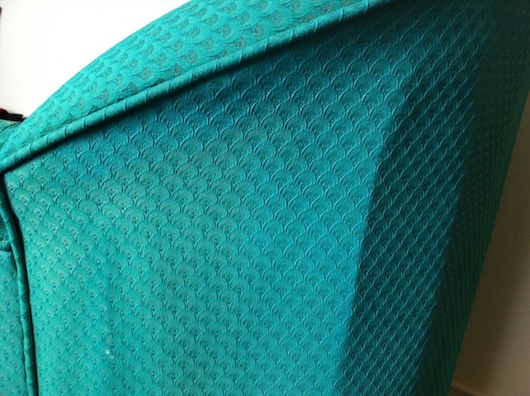
2nd coat – I COULD have left it here. It really looked fine…
9) Time to mix up your final coat! I used just a little less water than I did for the base layers. I used equal parts paint and fabric medium and watered it down to more of a cream consistency.
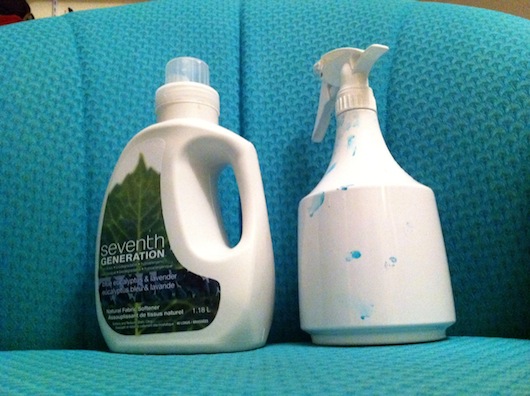
Totally optional step, but I feel it helped…
10) Add a couple of cap fulls of fabric softener to your refilled spray bottle. I sprung for something that smells wonderful. Why not? I’m saving money on the chair…
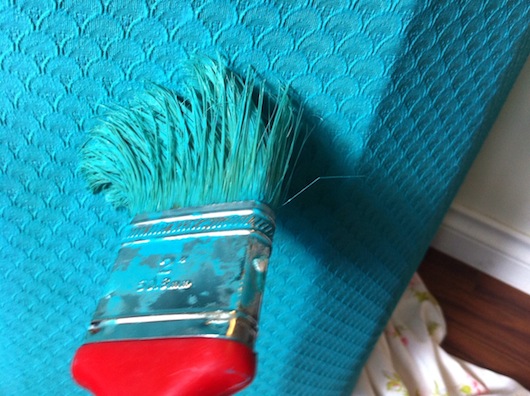
I painted in circles to really work the paint in
11) Start spraying your water/fabric softener mixture and begin painting. You want to lay on a little more colour with this layer as this will reflect the final result. Again, how you do this will differ with your fabric. I kept it pretty thin because of the non-absorbency of my upholstery, but I definitely painted in on more generously than my base coats.
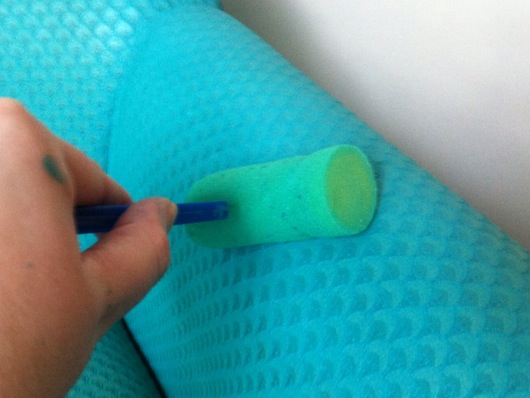
Keep on rolling
12) I continued to use the sponge roller to even things out.
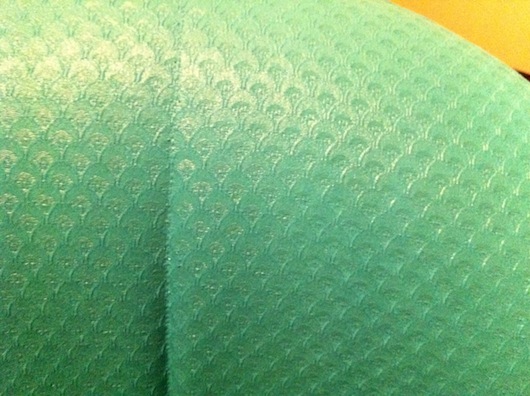
Looks pretty even-Steven to me
13) Take a good long look at the finished product. Make sure you use a smaller brush to get into the nooks and crannies. Check that things look even – this is your last chance before things dry.
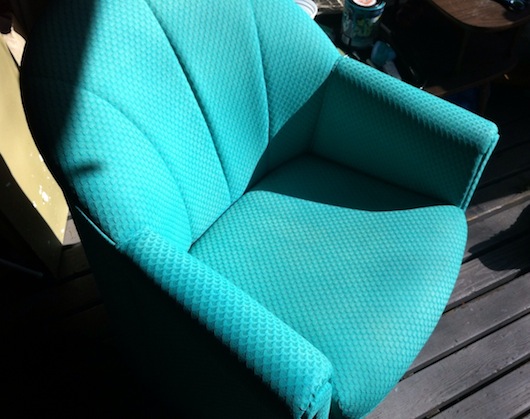
Drying in the sun
14) Let it be. I left my chair to dry in the sun (while it lasted) and for the rest of the day indoors with a fan on it.
The end result

Ta-da! The finished product. Not too shabby
I’m not going to lie, it looks pretty awesome. How does it feel? Hmmm…well, it’s not crispy or crunchy, but it’s not the kind of chair you want to snuggle up in and read for hours. Mind you, this wasn’t that kind of chair to begin with. It feels like of like a cross between pleather & painted canvas. I added another layer of paint to the arms of the chair without letting them dry completely and they feel a little more “latex-y” than the rest of the chair. I read that scrubbing the fabric with fabric softener and a little soap and water can soften things up. I’ll try it and report back.
But all in all, I’m pretty thrilled with the results. Thanks to the fabric medium, the paint doesn’t crack or peel and it won’t come off on clothing. It cost $30 and took me two days to finish the chair because I have kids and I had to start working on it at night. But you could probably do this in a day without distractions. I’m definitely going to try it again. It was a lot of fun and the end result is pretty satisfying. So, what are you waiting for? Search your local Used site for some diamonds in the rough and get creative. If any of you try this, I’d LOVE to see photos!
Useful links
Looking for stuff to paint and upcycle? Head to our furniture category.

UsedHQ
Chatter from the UsedHQ. We're the number one Canadian online classifieds, passionate about keeping items out of landfills, preserving unique curiosities, crafting, upcycling, anything vintage and SAVING MONEY!

erin
LOVE IT!
Bon
It’s fabulous. Great colour, and wow…I really had no clue you could do that. I am now looking at some chairs in my dining room with great interest….
LJD
Good idea! I am thinking of tackling the glider/rocker as I never really liked the red-brown velour.
Kristy Swain
Looks great! Thanks for sharing the link! So glad you were able to prove people wrong and love it.
Bosmama
I didn’t know you could do that! Amazing!
Sage Goode
Wow. I had no idea you could do this! I’m looking pretty closely at some of the chairs in my house … hmmmm …
Jennifer Aikman
Hi Sage,
You totally can and it’s totally easy. I truly enjoyed the project – it was great fun to watch the transformation.
Kathryn Saunders
This is fantastic! Sage if you want to make a day of it we could do it together…I’m looking at my wife’s favorite chair with a new appreciation for it’s retro style….
thanks for the idea Jennifer.
Jennifer Aikman
You’re welcome! Id love to see photos if you guys go ahead!
dee
was going to throw out a recliner I have, but will try this first.
Jennifer Aikman
Hi Dee,
Do it! I’m happy to report that I’m still totally in love with my chair. It’s softened up and it looks so good, I can hardly believe it. I want to invite people over JUST to ask them how they like my chair.
sofas | Julian
I love, I was looking for ideas to dye an old armchair plain fabric for my garden under a huge shadow, now I’ll try, I think here in my country there is a product. Thanks for sharing your wonderful ideas.
Sammi
I am thrilled! I NEED a chair but can’t afford a new one. All the used ones have been so hideous and I thought I’d be stuck with the hope-to-reupholster deal. This is a great solution. Even if I buy a used chair I’d still save money. Wicked. Oh and thanks for being lazy… no, really… I want steps I can skip.
Jennifer Aikman
Hi Sammi. If you do this, send me a photo!! I’m the laziest DIY’er on the block — so… anytime!
jennifer@usedeverywhere.com
Jean Hamilton
Will this work on a floral patterned loveseat? Ot will the original print show through?
Jennifer Aikman
Hi Jean,
The pattern will show through but not the print. You can see that the pattern of the chair I did is still visible.
If you do this, let me know! I’d love to see the end result!
Jennifer
Elle G
This is a great idea! I might just have to take a weekend and update an old couch (that has loads of character, but an awful colour.)
Sammy
Hey,
Just wondering if you got around to softening up the chair? I read somewhere else that over time the chair will soften up, and a quicker way to do it is through sanding it. I have these two beautiful old custom made SELIG couches… pretty sure it’s in a pale sea green corduroy. I keep wondering if I should just go straight with a fabric paint instead of acrylic or latex because it’s very fabric-ky just so I can keep the softness of the material…any advice you can think of is good though…
Jennifer Aikman
Hi there,
My chair has softened up considerably, but it IS a firm, synthetic material. I’m not sure how that would work with something as fabricky as corduroy… I did sand mine a bit, but I didn’t like the effect – it deadened the colour a bit. Again, that could be the material of the chair… I don’t see why you couldn’t go straight to fabric paint… I guess it can get expensive as you’ll have to use a lot to build up the colour. From everything I’ve read, soft upholstery painted with latex will never feel plush. I know in the US there’s a product called Simply Spray that is apparently pretty easy to work with. You can order it in Canada online via StencilSpray.ca. ANOTHER option is painting on Rit fabric dye. The colour is a little more natural, but can be lovely. Check out the gorgeous results Kara got with this method: http://karapaslaydesigns.blogspot.ca/2012/05/worn-and-weary-chair-gets-royal.html
I have a big, down-stuffed chair I may try the Rit treatment on…
If you go ahead and paint your couches, please, please, please share a photo!
Jennifer
Renueva tus muebles de tela con pintura - Decoracion - EstiloyDeco
[…] quieres una explicación más detallada y más fotografías, visita UsedEverywhere y HyphenInteriors Tweet Tags: decoracion economica, ideas economicas, muebles […]
ana
Hello my name is Ana I am from Central America thanks, I knew I could, I will paint my furniture both but first I need to experiment with something small, does not sell in my country fabric medium to do? please answer me I’ll be waiting for your answer.
Jennifer Aikman
Hi Ana, I’m afraid I don’t know of any substitution for fabric medium… As far as I know that’s the magic ingredient that makes it all work. The other option is buying fabric paint (the colour options are limited) or maybe buying a fabric spray paint online like Simply Spray – http://www.simplyspray.com/where-to-buy/
Sorry I can’t be much more help!
Jennifer
claudia anaya
Hola jennifer estoy en plan decoracion con poco presupuesto ya tapize mis sillas y me quedaron fantasticas y tengo los muebles de terraza que ya estan un poco deteriorado y me encuentro con tu idea fantastica voy a probarlo y te cuento son dos sofas otra cosa que te queria comentar ese color que pusiste en el sillon cual es por que ese es el color que yo quiero para los muebles un abrazo espero respuesta claudia Aruba
Stacey Lynn Newstead
Awesome idea! Who would have thought!!
Question..see you posted a while back.
How is the chair holding up? Any sign of paint cracking/peeling?
Jennifer Aikman
Hi Stacey,
Thanks for asking! We use the chair daily and it’s held up perfectly. No cracking, peeling or fading. In fact, it’s the perfect piece of furniture for toddlers because liquid beads off of it. So, I highly recommend it!
Jenn
Sylvia Martin
I have a chair and a couch, and I’m definitely going to try it, first with the chair.
If it turns out okay, then I’ll do the couch.
I was going to purchase a new set, but this is a lot cheaper, and I’ll have the colour I want.
Thanks.
dave
Hi Ana, I’m afraid I don’t know of any substitution for fabric medium… As far as I know that’s the magic ingredient that makes it all work. The other option is buying fabric paint (the colour options are limited) or maybe buying a fabric spray paint online like Simply Spray –
Thanks for the info I tried brite red upholstery fabric paint from sspray.ca as you adviced and it worked perfectly . Thank you so much for your help i didn’t know we can paint upholstery fabrics 🙂
Norma
I have a fabric medium substitute. Glycerine. You can get it at any pharmacy. You mix it with water first 1 part Glycerine to 5 parts water. Then add it to any acrylic paint. 1 part diy fabric medium to 5 parts paint. I am doing my upholstery in my camper and it is working great. I do sand in between coats.
Judy
This is so cool! Thanks for taking the time to explain it so simply. We just bought 4 tealish barrel chairs from a thrift shop. I think they look cool and retro-y, but my family thinks they’re ugly. So, we have nothing to lose here by painting them, although it will take a lot of time.
PacificOutdoorFabrics
Awesome! But would the paint last or won’t it destroy the chair? Just curios of it since I want also a anew look for my sofa and this seems interesting to imitate.
Bonnie
So exciting. And I’m thinking if it doesn’t turn out, then you can take off the painted fabric and go to first thought – re-upholster. I have a wood leg and frame, fan back 1940s very comfy chair. The fan back is very cushy and comfy. My question is this. The fabric was the green textured fabric of the day (they either came in green or burgundy – remember those). It is quite smooth now, with kind of a “patina” as it were. On steam cleaning that never came off, and I’m not sure if its a greasy dirt like one might get in a kitchen from flying particles.- I’m guessing. This is why I want to paint it, because now with this its actually two different greens. Do you think this issue of this “patina” will cause a problem with the painting.
danielle
I have tried upholstery spray paint in red color for my project and i liked the result . try simplyspray.ca for promos
Lil Ott
I just painted my recliner/rocker yesterday. My first project. One part medium to two parts paint. I didn’t let it dry between the two coats so hopefully will finally dry. I feel I will have to soften the fabric. Should I lightly sand, use fabric softener? It the color not going to rub off when sat on? The color is beautiful and matches other pieces of my existing sofa perfectly. Hope I haven’t messed this chair up!! Any advice??
Deborah
WOW! this is the most amazing , inexpensive solution to re-upholstery! i am dying to try my couch and chair! nervous but excited ! I AM DOING IT!
Desaline Perry
So like you I read every bit of info I could find about painting a chair. I wanted to try different options and I started with the latex way. I think it came out really nice. Everyone loves the chair. It has a kind of pleather, vinyl feel, but it’s a good seating chair. No transfer of color and I’m ready to tackle my $50 sofa. This chair was only $10. The paint was $5. Fabric Medium cost me about $10 bucks. And throw in three days of patience and waiting. I would say, it was a tremendous success. Especially for a first timer and a complete novice at repurposing furniture. Just bought a house and decided to refurnish it on a slim budget. Wish I knew how to add my picture for you to see before and after. Thanks for the tips. Next project I’m going to use Chalk paint and compare the techniques. Wish me luck.
UsedHQ
Send your before and after photos to me at nicki@used.ca! We would love to see them.
powerful love spells
Hello,I log on to your blog named “Used.ca | You can paint upholstery? Yep, here’s how. – Used.ca” like every week.Your story-telling style is awesome, keep it up! And you can look our website about powerful love spells.
Terry
I’ve read tutorials on several sites, looking for the best, simplest, and cheapest way to do this. I really like that you did the same. Your tutorial was great! My chair’s upholstery looks the same as yours, just different color–kind of a faded apricot. I got numerous free sample jars of Valspar paint in the eggplant purple color I wanted a couple of years ago, but have just never got around to doing this. I was told the paint is a latex-acrylic combo. I’ve since read that acrylic can cause it to be stiffer. You said when you sanded it deadened the color a bit. Would it make a difference if you only sanded the first and 2nd coats? Also do you know if anyone has had better success using glycerin than fabric medium like Norma suggests? Moving soon, so really want to get my chair painted beforehand.
Renee
I painted a couple of matching white chairs and a footstool. I used one coat of 50-50 dark latex paint and water followed by sanding. Sadly, I got excited by how well it was working and over sanded the second chair. It weakened the ribbed fabric and it ripped along multiple ribs. Don’t over sand!